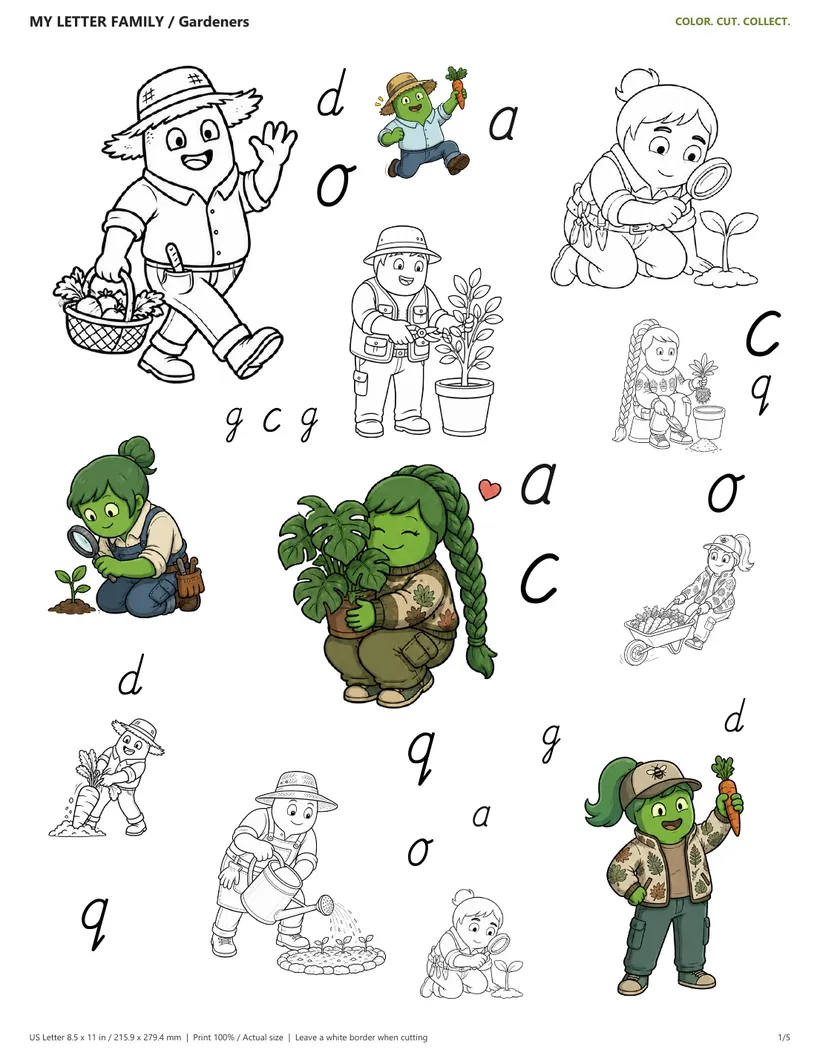
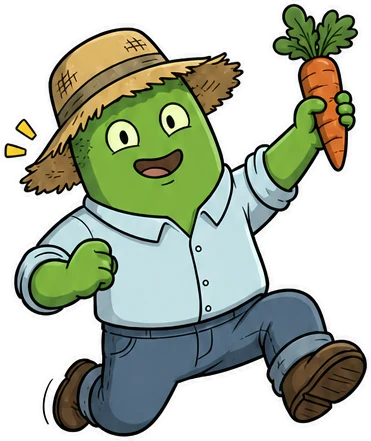
 Cursive
The Gardeners
They grow things, so their letters start with one little curve.
cadogq
Every letter here is built from c.
When each letter is still hard work, nothing is left over for what your child wanted to say. We group letters by the hand movement they share: learn c, and you're most of the way to a, d, o, g and q. Five to ten minutes a day.
You're on the list. We'll send the worksheets the moment they're ready, and one note the day the app goes live.
Your download is ready below.
That email doesn't look right. Could you check it?
We couldn't reach the server. Check your connection and try again. Your email wasn't lost.
Something went wrong on our side. Please try again in a minute.
Printable worksheets to practice on paper, plus a note the day we launch.
They worry about what it drags with it. Writing is the one school skill a child cannot avoid, so the trouble never stays in the handwriting.
A child who keeps failing at writing starts avoiding it: the slow start, the one-line answer. That spiral is far easier to interrupt than to reverse.
Until writing runs by itself it eats the attention your child needs for what they want to say. The work then reads as weaker than the child is.
Handwriting affects the grades given for language and spelling. Two children can write the same answer and not be scored the same.
Children who learn letters by writing them read and spell better than children who tap them out. The hand teaches the eye.
A keyboard asks a finger to find a key. Writing asks the hand to make a shape. Typing well does not carry over to a pencil.
A finger teaches where the letter goes. A stylus also teaches the hand to grip and steer it, which is what a pencil asks for.
Neater letters do not fix this. The hand knowing where to go unprompted does, and that is what a few minutes a day on shared movements builds. See how the method works →
The Builders put up ladders and beams, so their letters are straight. The Athletes run and jump, so their letters lean. The Gardeners watch things curl open, so their letters start with one little curve.
On its own a letter is an abstract squiggle, and abstract squiggles are hard to hold on to. Tied to a family it stops being abstract. Your child remembers what the Gardeners do, and the curve comes back attached to it. The family's trait is the handle; the movement is what it lifts.
Start wherever your child is. Block capitals are bigger targets and simpler strokes, so they suit a younger or less confident writer. Cursive is the main event. Either way the letters arrive in families, and every family shares one movement.
Cursive
They grow things, so their letters start with one little curve.
Every letter here is built from c.
 Cursive
They play music, so their letters swing up high and come back down.
Every letter here is built from e.
 Cursive
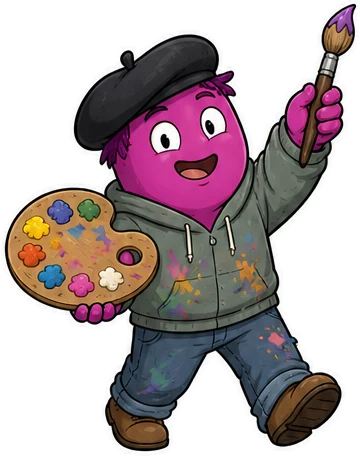
They paint and draw, so their letters drop straight down.
Every letter here is built from i.
 Cursive
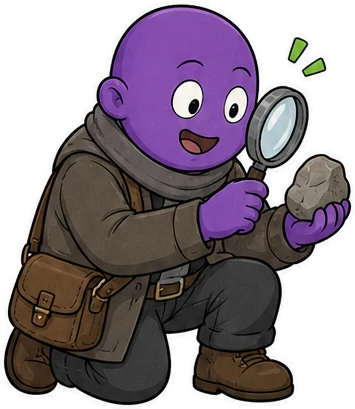
They test things and find out how they work, so their letters go down, then arch over the top.
Every letter here is built from n.
 Cursive
They go places, so their letters turn sharp corners.
Every letter here is built from v.
A few of the 9 families. Start with whichever set suits your child.
The hand learns movements, not pictures. Group letters by the movement they share and learning one carries into the next. a is c plus a stick, d is a with the stick taller, o is c closed at the top. Alphabetical order jumps between unrelated movements every single day.
It is also why b and d sit in different families. They are the pair children mix up most, precisely because they look like mirror images, but in the hand they share nothing. Taught apart, they become two clear movements instead of one confusing picture.
Every letter goes through the same three steps, so your child only ever has to learn a new letter, not a new screen. What changes is how much help is on the line.
The letter shows your child how it is made, then they trace it.
The guides fade. Your child writes it, and the family’s world answers.
Lined paper, a dot to start on, and nothing to copy.
Your child writes the letters themselves, not just over them. Tracing is where we start. Writing from memory is where we finish, because paper has no outline.
Progress shows up in a parent view behind a parental gate, free on every plan.
Type your child's name, pick a family, print. No account, nothing to sign up for. The letters and the order are the ones the app teaches, so what comes out of your printer is the method, not a sample of it.
Leave your email and we'll send the printable worksheets now, and one note the day the app goes live. Nothing else.
You're on the list. We'll send the worksheets the moment they're ready, and one note the day the app goes live.
Your download is ready below.
That email doesn't look right. Could you check it?
We couldn't reach the server. Check your connection and try again. Your email wasn't lost.
Something went wrong on our side. Please try again in a minute.
Printable worksheets to practice on paper, plus a note the day we launch.
Launching this back-to-school season on the App Store.